How to prepare the biological treatment plant for winter and what to do if no one lives in the house?
As the cold weather approaches, the question becomes relevant for the owners of private houses and summer houses: how will the severe frost affect the biological wastewater treatment plant?
The biological plant is not a simple tank - it is a living ecosystem of microorganisms. In order not to experience unpleasant surprises in winter (frozen pipes, damaged compressor or destroyed bacteria), it is worth taking care of its proper preparation and operation in time.
1. Can a biological treatment plant freeze in winter?
Short answer: a correctly installed and constantly used plant usually does not freeze.
There are two main reasons for this:
- Biological processes: Activated sludge generates heat during the wastewater treatment process.
- Warm wastewater: Regular use of the shower, washing machine or dishes washing machine, warm water continuously flows into the tank.
The main risks of freezing in practice:
- Antagonism or wrong slope of the pipes: Most of the freezing happens not in the tank itself, but in the inlet/outlet pipes. If the slope is not accurate (optimally 1.5-2 cm per 1 meter) or the pipe has settled, a water "pocket" forms in it, which quickly freezes at -10°C.
- Too shallow investment: Pipes are buried above the freezing point without additional thermal insulation.
- Long snowless winter: If the air temperature is below for a long time -20°C and no snow cover.
- The house is not inhabited: The flow of warm wastewater is not provided.
Important advice: Never remove snow from the cover and surface area of the treatment plant! Snow acts as a very effective natural heat insulator.
2. Practical steps to insulate the device before frost
Preventive work takes little time, but protects against expensive repairs:
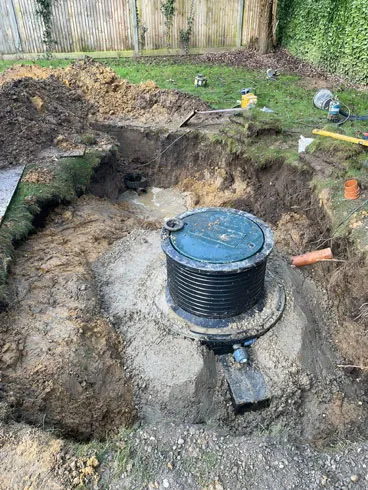
- Insulate the hatch cover: Most of the heat escapes directly through the cover. A sheet of extruded polystyrene foam (XPS / styrofoam) or a custom insulation element is recommended under it.
- Check the air supply: Make sure that the air intake mushroom and openings are not covered with snow or clogged with leaves. The compressor needs a free supply of oxygen.
- Heating cable for critical stages: If the pipe is laid shallow in some places (for example, crossing foundations), a self-regulating heating cable with a heat insulation jacket can be installed on it.
3. What to do in holiday homes or cottages in winter?
The action plan depends directly on how often the house is visited during the cold period.
Scenario A: You only stay in the house on holidays
- The compressor MUST NOT be turned off. The air supply must work continuously, because bubbling, moving water does not freeze, and it also keeps bacteria alive.
- Electricity consumption: Modern compressors consume an average of 40-70 W (about 4-8 € per month), which is much cheaper than growing new bacteria and replacing damaged nodes.
- Insulation of the lid: In this mode, mandatory, because there is no hot water supply during working days.
Scenario B: The house is completely preserved for 3-6 months
If the building will not be used in winter in general, the system must be properly prepared for downtime:
- NEVER leave the tank empty! An empty tank in winter or spring thaws can be deformed or literally "squeezed" out of the ground due to ground pressure and high groundwater levels.
- Evacuate excess sludge: Call the sanitation company before the end of the season, but make sure that there is water in the tank after maintenance at the required working level.
- Switch off and cool down the compressor: It is recommended to dismantle the compressor and electronics and place them in a dry, warm room to protect the membranes and the motor from condensation and frost.
- Insert ice compensators: A few 1.5-2 liter plastic bottles half filled with sand can be immersed in the tank chambers. If the surface freezes, the ice will press the bottles, not the body of the machine.
4. How to maintain the viability of bacteria without sewage?
Biological plant microorganisms need two basic things: oxygen and organic food.
- Absence up to 2-3 weeks: Bacteria successfully go into "sleep mode". After returning, it resumes full functioning within a few days.
- Absence for 1-2 months (compressor on): To prevent bacteria from dying from lack of food, before the absence (or entrusting it to a neighbor/friend once a month), you can pour 1-2 liters of kefir, buttermilk or dissolved dry yeast with a little sugar into the toilet bowl. This organic matter will serve as a source of food.
- After full wintering (in the spring
Recommended Products
Related Articles